Reflections on another workshop at ISMETA, Spain Conference 2025
By Crystal Robbins
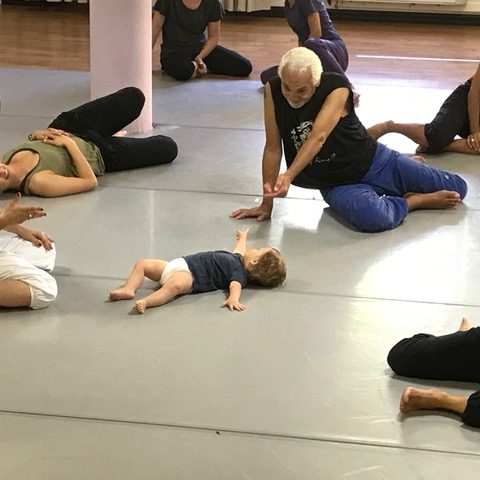
Creating Communication to Nature through Developing the Sensitivity of the Body with workshop presenters Katinka Sanchez Elsner (Spain) and Anna Karina Heimler (Germany), shown above (photos provided by Crystal Robbins and Anna Karina Heimler)
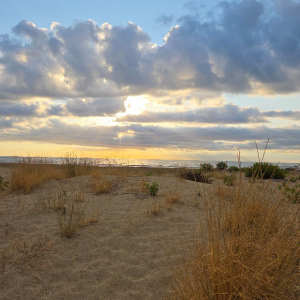
On the first day of the ISMETA Conference in Spain, after breakfast and before the first session, I walked the five minutes to the beach. I crossed the small road and took a tiny path that led to the boardwalk, and walked straight out to the water. I found a little sandy knoll with some tall grasses waving in the breeze, and took pictures of the start of the day looking over the sea. I even recorded a 10 min vocal tune-up there for my youtube channel [1], sitting on the little dune with the morning sun behind me. There were sandy colored grasses, long and tall, and they reminded me of grain waving across the plains.
When I left the first workshop which I wrote about in my last article [2], I took the break between sessions to try to encapsulate what had just happened. So I missed the opening of the second workshop by a few minutes, including the initial introduction. When I entered the space, everyone was on the floor in a big circle coloring. I was handed a piece of paper and I grabbed a pen from my backpack.
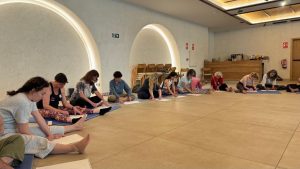
The invitation was to “paint/draw whatever I was feeling or anything present for me at this moment in the workshop or in relation to the group and the process.”
I didn’t think and began to sketch. I didn’t know where I was going, but discovered that I was sketching the tall grasses on the little knoll. I sketched a beach and a horizon. I put the mounded area I had seated myself on slightly off center and the shoreline and waves distant behind. I sketched in tufts of the grain-like colored grasses, and random low curls and hardier tendrils on the sandy mounds. Some waves featured in the distance, the sun and mackerel sky above them. I’m not an artist, but I just gave myself permission to do my best/worst like I always tell my students. I didn’t have a color, I just had my pen; and I didn’t grab a color as I thought it would be disruptive. I discovered that my morning beach was what I was feeling in my body. It brought to mind the cool breeze, the warm sun, the pace and rhythm of the sea, the briny smell of salt and life and blood. It hinted at storm, but the sun won out. It reminded me of the hum of the trash can pick up trucks I heard along the shore, and the humming I began to do in accompaniment, making music out of the environment. It felt like what I knew of Spain in my now brief second full day in the country.
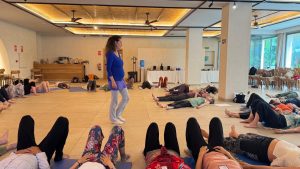
We then went into a series of movement prompts related to our drawing and what the experience of the drawing made us feel in our bodies. I remember discovering how my drawing prompted me to move as all the varying components of the sketch each asked for different experiences and shaping of space. We were invited to move through space, to interact and exchange parts of our movement with others, to give and take and share. I experimented with what wanted to come first in my drawing/bodydance. Then I noticed the sounds began to come as my body interacted with space/wood/furniture/textures. I began to create something, without judgement, without expectation, without inhibition.
Of course, it goes without saying that in my body this also means that the Lessac body pain relievers of float, shake and yawn were showing up. In my body, the expressions of buoyancy, variations of potency and dialects of radiancy showed up. But also the languaging from our Lessac Kinesensic Vocal Energy dynamics [3] found its way into the playground of my physical expression, as physical parameters to give me different variations of exploration:
Long vs. Short: As related to the length of time in exploring a given movement expression,
High vs Low: As related to how the movement feels when explored at different levels,
Connected vs Paused: As related to whether there was continuous flowing movement or movement with pauses to a perceived beat (My still point work derived from Marcela Widrig’s Stopping Movement/Grinberg [4] work informs this.)
Concentrated vs Dilute: As related to the movement being very focused, pointed, and direct in composition or more expansive with a feeling of the molecules of the body further apart.
Fast vs Slow: As related to pace.
Voice vs Unvoiced: As related to the sounds the body was making in the space. What was the movement like when the body made sound, or when it was silent? And by this, I literally mean the slap of the foot or the arm or the body in connection to environment. I’m not at this moment speaking of the vocal accompaniment, Although that might factor in: breath, huffs, soundings.
Now we went back to our drawings and the prompt was to turn the drawing over and again we were invited, but this time using the back side of the page: “What are you feeling in your body/what is present for you right now?”
I grabbed a yellow crayon this time and still had my pen. On the back side of the page I accepted the challenge and without thinking of anything, started scratching my pen on the page. I noticed I had placed the page vertical rather than horizontal, and I had a brief moment of “ah, no, I didn’t mean to do that;” but it was a pen and I had to go with it and so I did. I continued to scratch. I noticed I was more liberal and joyful in my strokes. They were bigger and longer, I played more. I took more risks, I experimented more. I drew larger circles and undulating lines.
I stepped back and looked and grabbed my yellow crayon and the scratches became the grasses waving in the breeze or the explosion of sun, bigger now. Or lightly colored, the pen and gentlest yellow created the sand and the little dune. I flipped the page over and added the color on the first drawing. With the color in hand, I could give more dimension and texture to that one and I supplied that: gentle dune-like slopes, and the tufts of grasses, ocean and sun in their respective spots as I had interpreted them first.
We were now prompted to consider both of our drawings. Here is what I observed.
The picture at the beginning was like a landscape picture. I was further away, the perspective was from a distance, with all the action/activity happening from several feet away and spreading to the horizon. With that distance I felt there was also emotional distance, although I had been quite pleased with this when I did it. It still looked pleasing and satisfactory and approximated in my mind’s eye the scene of where I had recorded my tune-up. It had not been devoid of feeling in the creation of it. But it was reserved now that I looked at it and had a feeling of being held at arm’s length. In turning the page back over and looking at the second picture, I was suddenly struck at how much closer I was to the subject matter. Indeed, it seemed I was in the middle of the experience. I was IN the beach scene, IN the grassy, sandy, dune-like knoll, like I was sitting right in the middle of it. I was not removed or at a distance.
I felt a different perspective of being ‘in the body’. After moving and shaping the body in connection to self and others and physicalizing my relationship to that which I drew, I was able to enter more deeply into not just my body, but in the landscape of the lens with which I visually experienced myself. I noted I had now completely unwittingly literally drawn myself more deeply embedded in the world of sand and grass, sky and sea. What sort of relationship opened up for me inside to sense this? In terms of my personal connection, was I discerning a different relationship for the grass that is now all around me, gently surrounding me while the wind wafts it and I respond gently. Had I moved from intruder to observer to being a part of the inner foldings of the landscape? My body had just shown me that kind of languaging as it interpreted the first experience and then the pen and crayon leapt to show that before my mind conceived it. [5]
I considered how each of those stages feel in the body. I began a compassionate conversation between sense of self and relationship to my environment as I allowed the body to just feel. I imagined myself lying down in the sand, which I had not done in my real-life morning experience, but I did in my mind’s eye then, in the workshop room in Spain, I took a breath.
If this wasn’t the point of this experience, it surely gave me a lot to think about.[6]
Presenters Katinka Sanchez Elsner (Spain) and Anna Karina Heimler (Germany) are presenting an online 3-session deeper dive similar to this experience called Embodied Learning, Group Dynamics and Creative Perception through ISMETA this September. Check it out here: https://ismeta.org/course/embodied-learning-group-dynamics-and-creative-perception
The Lessac Institute offers regular online workshops. See here: https://www.lessacinstitute.org/online
Sidebar:
Practical applications
- The prompt: “What are you feeling in your body (or bodyvoice, or voice) or what is present for you right now?” are all good prompts to draw/color in both a ‘before’ and ‘after’ experience. I’ve done this as part of assessments/research when working with children and teens, but it is equally valuable when working with adults. I was thoroughly shocked by my own drawings, perspectives, and intuitive responses to what I observed. I am reminded of work with drawing that I’ve seen Certified Trainer Kathy Dunn do at a Lessac Conference presentation and acknowledge that resource.[7]
- The prompt to move your body in the style or suggestion of what you have drawn, gives permission and freedom to stylistically make choices one wouldn’t have normally made, or for example, in a less realistic way. In my classroom, with a group of very new actors, very shy and unsure about what and how to move, this experience unlocked more varying movement potential and freedom. There was no judgement as the paper was personal, there was no expectation or oversight into the validity of their choices.
- The prompt allows the participant to meet themselves where they are. They may or may not make connections, discoveries. They may be quite literal, they may be abstract in their interpretations. Both can be accepted.
- The prompt supports different ways of learning and understanding and recording one’s experiences.
- The prompt can be done in a large classroom, doesn’t require showing the work to others for feedback as it develops the ‘teacher within’. [8]
Notes from article:
[1] Tuning up in Spain as accessed on youtube 1/4/26 https://youtu.be/fZsPZmq-2a8?si=avMWd7Bj-fxxNeJX
[2] Robbins, Crystal “Come Spar With Me In Spain”, https://www.lessacinstitute.org/spar-in-spain, as accessed via internet 7/15/2026,
[3] Handout printed in the workbook from the Lessac Intensive Workshops define these ‘vocal dynamics’ used in bodyvoice training. Although originally conceived in relation to voice, my application and interpretation can also apply to dynamic movement options. Additionally Lessac abbreviated “energy” to NRG in his writings, which also stands for Neuro-Regenerative Growth. Both ideas apply when he uses it as the body and vocal NRGs stimulate new-born creative images, ideas and output, while giving energy and strategically using energy efficiently and with ease.
[4] Embodiment Coach Marcia Widrig trained in Avi Grinberg’s work exclusively for 18 years before also training in Body-Mind Centering® , Embodied Yoga™, and Theatre Motion® . Her use of Grinberg’s “Stopping Movement” , a parameter-based way to explore the body moving in space, was a joyful discovery for me ten years ago and I continue to enjoy it. Widrig’s Fierce Embodiment unites her various somatic and therapeutic modalities. When sharing about my work with Lessac, she gave me permission to explore the intersection between her work and mine and we both presented at the Southern California Regional Lessac Conference at USC in January 2018. I call my version of that intersection of work “Still Point Work” as it uses Lessac parameters rather than Grinberg’s. Read more about Marcia at www.fierceembodiment.com.
[5] I am moved to consider a quote that Arthur Lessac attributed to pianist Arthur Rubinstein “If my fingers hadn’t done it, my mind would never have conceived it.” as noted in the January 2010 issue of American Theatre Magazine. https://www.americantheatre.org/2010/01/01/a-quest-for-the-original-voice/
[6] The movement sequences presented in this workshop were based on the work of Moshe Feldenkrais and the Feldenkrais Method® . Workshop presenter Katinka wrote to me that “painting and using creativity is an intelligent tool for supporting neurological processes, because it activates different parts of the brain and helps people enter a different brainwave state.” She noted it valid “to compare the beginning of the process with what happens after coming into contact with the environment, the group, the community, and yourself–feeling gravity, becoming aware of your bones, your breath, your movements, your pain, and your attention”. Personal communication via What’sApp, July 10th, 2026.
[7] Certified Trainer, and one of my mentors in my training, Kathleen Dunn Mancuso led a workshop at the 2011 Lessac Conference in Vista, CA related to ‘stepping into story’ and creatively used paper and writing implements to help situate the actor into their present moment. I am reminded of that application in sharing this experience.
[8] In Lessac work, Retired Master Teacher Barry Kur termed the phrase ‘the teacher within’ to suggest the organic biofeedback loop of our Kinesensic self-teaching process as one facilitates for oneself any embodied knowing. It trusts that one is always learning and growing, that it is indeed our natural habitat as a human. Developing trust in our teacher within is part of any Lessac workshop and a huge resource for well-being.
About the author: Crystal Robbins is a Los Angeles based Lessac Master Teacher of Bodyvoice. She currently facilitates that work at Santa Monica College, UCLA-Extension’s Professional Actor Training Program, The Lessac Institute and privately. She is a Registered Somatic Movement Educator with ISMETA. www.lessacinstitute.org, crystalrobbins.com